Aorangi Stadium Redevelopment
Work is underway on one of the most significant community projects in Timaru's recent history, the $24.2 million redevelopment of Aorangi Stadium on Morgans Road, the home of indoor sport in South Canterbury.
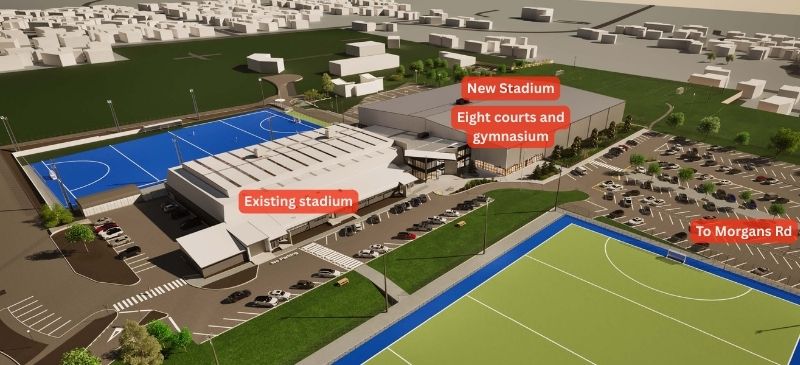
The project will deliver a strengthened existing stadium, a brand new eight-court indoor sports facility, and a link building connecting the two all designed to serve our community for decades to come.
What's being built?
The redevelopment has three main components:
Upgraded existing stadium - The current Aorangi Stadium has been seismically strengthened and had its fire systems upgraded, with the building reopened to users in January 2026.
New eight-court indoor stadium - Built on the site of the former netball courts, the new facility will be capable of hosting regional and national-scale tournaments across basketball, netball, volleyball and more.
Link building - Connecting both stadiums, the link building will include a gym, function rooms, and improved changing facilities.
Together, the completed complex will also be available as a disaster recovery centre if needed.
The project is being designed and built by Timaru-based company Thompson Construction and Engineering.
Note: these images are indicative only, design features may vary from what is shown
Stay up to date
Subscribe to Courtside Seat, a behind-the-scenes look at progress of the Aorangi Stadium Redevelopment.
Where are we now?
Seismic strengthening and fire system upgrades to the existing stadium were completed in early January 2026, with the building handed back to the Council and reopened to users shortly after. Sport Canterbury has also returned to the facility.
Work on the new eight-court stadium building is continuing, with full completion of the entire redevelopment expected in mid-2027
Why is this happening?
The stadium upgrade was included in the 2021–2031 Long Term Plan and carried through into the 2024–2034 LTP and capital works programme. The existing facility, while well-used and loved, needed significant strengthening and expansion to meet the growing demands of our sporting community.
Participation numbers tell the story, netball, basketball, and volleyball in South Canterbury have all seen strong and sustained growth in recent years, and the current facility was no longer able to keep pace with that demand.
The new facility is designed to meet the needs of current and future sports users, while continuing to offer space for large events and conventions.
History of Aorangi Park
Aorangi Park has been South Canterbury's home of sport for more than 50 years, the development of area started nearly 20 years prior.
The first land was acquired in 1953, fronting Mountain View Road. The following year the largest block of land, fronting Morgans Road, was added to the site. The park as we know it today covers 13 hectares in the Gleniti suburb of Timaru, accessible from both Morgans Road and Mountain View Road.
Despite the land being secured in the early 1950s, development did not begin until 1970. The park was formally named Aorangi Park in 1972, and the stadium and netball courts were developed in 1974, with the first sports field following in 1975. Development of the wider park continued through the 1970s.
From those beginnings, the park grew steadily into a multi-sport complex serving the whole district hosting athletics, bowls, cricket, football, hockey, netball, and tennis, alongside the indoor stadium that became home to basketball, netball, and volleyball.
Cricket has been one of Aorangi Park's proudest traditions. List A cricket was first held at Aorangi Oval in the 1980/81 Shell Cup, when Canterbury played Wellington. First-class cricket arrived in February 1998, when Canterbury hosted the touring Zimbabwe side. The ground has also hosted international women's cricket in November 2000, Aorangi Oval was the venue for two Women's One Day Internationals between New Zealand Women and England Women. Today the oval serves as headquarters for the South Canterbury Cricket Association.
Timeline
Civil works and utility diversions begin on site
Existing stadium handed to Thompson Construction and Engineering for seismic and fire system upgrades
Existing stadium reopened and work begins on the new eight-court buidling and link building
Full project completition expected
Community Fundraising
The Aorangi Stadium redevelopment has a community fundraising target of $2.4 million, every dollar raised is a dollar less that Timaru District Council needs to spend and, ultimately, reduces the long-term financial burden on ratepayers.
A community-led fundraising committee, supported by the Aoraki Foundation, has been established independently of Timaru District Council to raise this contribution.
The campaign, which launched in April 2026, is seeking donations, sponsorships, and grants from individuals, businesses, sports clubs, and community trusts across South Canterbury.
Timaru District Council supports and welcomes the fundraising effort. The more the community gets behind it, the better the long-term value of the project for everyone in the district.
To find out more or to make a contribution, visit aorangistadium.co.nz
Last updated: 14 Jul 2026