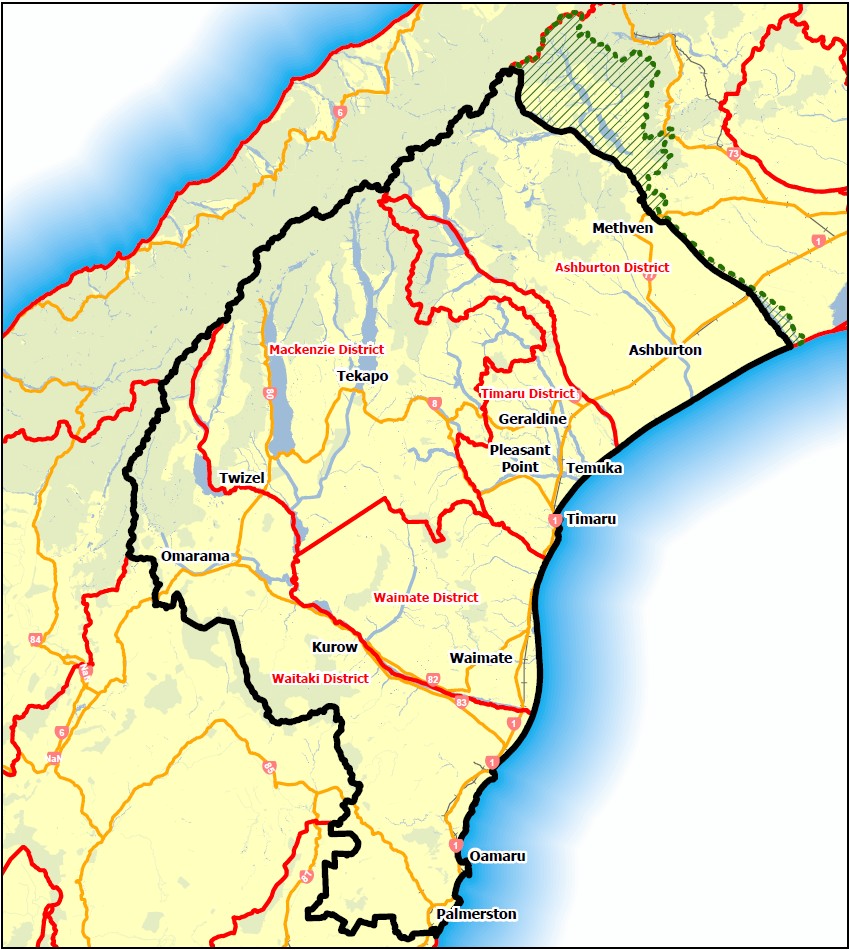
 A Mid-South Canterbury & North Otago Unitary Council based on either territorial or river catchment boundaries
Size (Territory)
26,715 sq km
Population: (approx)
125,400
GDP: (approx)
$10.5 billion
Assets: (approx)
$5.7 billion
This option would create a new
unitary council covering:
- Timaru District;
- Waimate District;
- Mackenzie District;
- Ashburton District; and
- Waitaki District
And optionally (extended part of map)
- the Rakaia River catchment currently within the Selwyn and Ashburton Districts.
This option would bring together five districts with a combined population of just over 125,000 people. It provides the greatest scale of
the options and the most integrated territorial approach to managing major rivers such as the Waitaki and Rangitata and Rakaia, but is also the most complex arrangement.
| Possible Advantages | Possible Disadvantages or risks |
|---|---|
| Creates the largest organisation of these options with the greatest scale and capability. | The larger boundary may make some communities feel more distant from decision-making, and local voice arrangements would need careful design. |
| Better aligns local and regional functions in one council, including management of major rivers such as the Waitaki and Rangitata and optionally the Rakaia. | Detailed arrangements for assets, debt, staff, services and representation are not yet known. |
| May provide the strongest long-term planning for infrastructure, land use, freshwater, transport and economic development. | There may be transition costs before any efficiencies are achieved. |
| May provide stronger long-term planning for infrastructure, land use, freshwater, transport and economic development than current arrangements, although with less scale than the larger options. | Ashburton’s and Waitaki’s strongest links may differ across communities, with some connections north toward Greater Christchurch and some south toward Otago/Dunedin. |
| Gives local councils and communities more influence over the shape of reform than waiting for the backstop process. | Agreement would be needed with other councils and the Government. |
| Could reduce some duplication between district and regional council functions over time. |
Including river catchments (highlighted in green)
- This option also recognises that some regional council functions, such as river management, flood protection
and freshwater management, work most logically across catchments rather than existing district council boundaries. - Including the Rakaia catchment could reduce some shared river management complexity, but may also introduce new boundary and catchment management questions, including how complex sites such as Te Waihora / Lake Ellesmere would be managed.
- Including parts of existing neighbouring districts would add complexity, and local voice arrangements would need careful design.
- This would add the additional cost of river management in these areas which may not be fully met by rates from
the number of rating units gained. - There will be boundary, rating, asset and debt-splitting issues that would arise from including.
Other options:
Option A: A South Canterbury Unitary Council based on either territorial or river catchment boundaries
Option B: A Mid-South Canterbury Unitary Council based on either territorial or river catchment boundaries
Option D: Do not submit a Head Start proposal and enter the backstop process.
Option E: Other option – You may prefer another arrangement.
Last updated: 24 Jul 2026