Help us understand what life is like in our community
Timaru District Council's Community Partnerships team and the National Public Health Service wants to better understand the experiences, needs and aspirations of disabled and neurodivergent people and their whānau across our district.
This is about everyday life in our communities, not just Council services.
We want to hear about the places people go, the things they do, the people they connect with, and the services and support they use.
That could include experiences with clubs and activities, schools, workplaces, businesses, transport, public places, community groups, services and Council facilities.
We want to understand:
- what's working well;
- what's difficult or gets in the way;
- what people are already involved in locally;
- what people would like to be involved in but can't;
- how easy it is to find information, services and support;
- what's missing;
- whether disabled and neurodivergent people have enough opportunities to have a say in decisions that affect them; and
- what could make life better and our communities more accessible and inclusive.
We want to hear directly from disabled and neurodivergent people, as well as whānau, carers and others who support them.
Have your say
There are different ways you can take part.
Complete our survey
Our survey asks about everyday life in the Timaru District, including what you are already involved in, what works well, what can be difficult, finding information and support, having a say in local decisions, and what you think would make a difference.
You can complete the survey yourself or with support, and you don't have to answer every question.
Let's Talk: Disability and Neurodivergence – Fill out form
Come along to a Community Kōrero
We are holding Community Kōrero in Timaru, Geraldine and Temuka.
These are relaxed opportunities to talk with us about your experiences and ideas.
You are welcome to come on your own or bring a whānau member, friend or support person.
Timaru
Monday 9 November
6.00pm–8.00pm
Council Chambers
Monday 23 November
10.30am–12.30pm
Council Chambers
Geraldine
Wednesday 11 November
10.30am–12.30pm
Geraldine Library and Service Centre
80 Talbot Street, Geraldine
Tuesday 17 November
6.00pm–8.00pm
Geraldine Library and Service Centre
80 Talbot Street, Geraldine
Temuka
Monday 16 November
10.30am–12.30pm
Temuka Library, Service & Information Centre
72 King Street, Temuka
Tuesday 24 November
6.00pm–8.00pm
Temuka Library, Service & Information Centre
72 King Street, Temuka
Can't make a Community Kōrero?
You can still have your say.
You can complete the survey, or if a group setting or online survey isn't right for you, you can talk with us directly.
We want people to be able to participate in a way that works for them.
Contact jessica.hurst@timdc.govt.nz
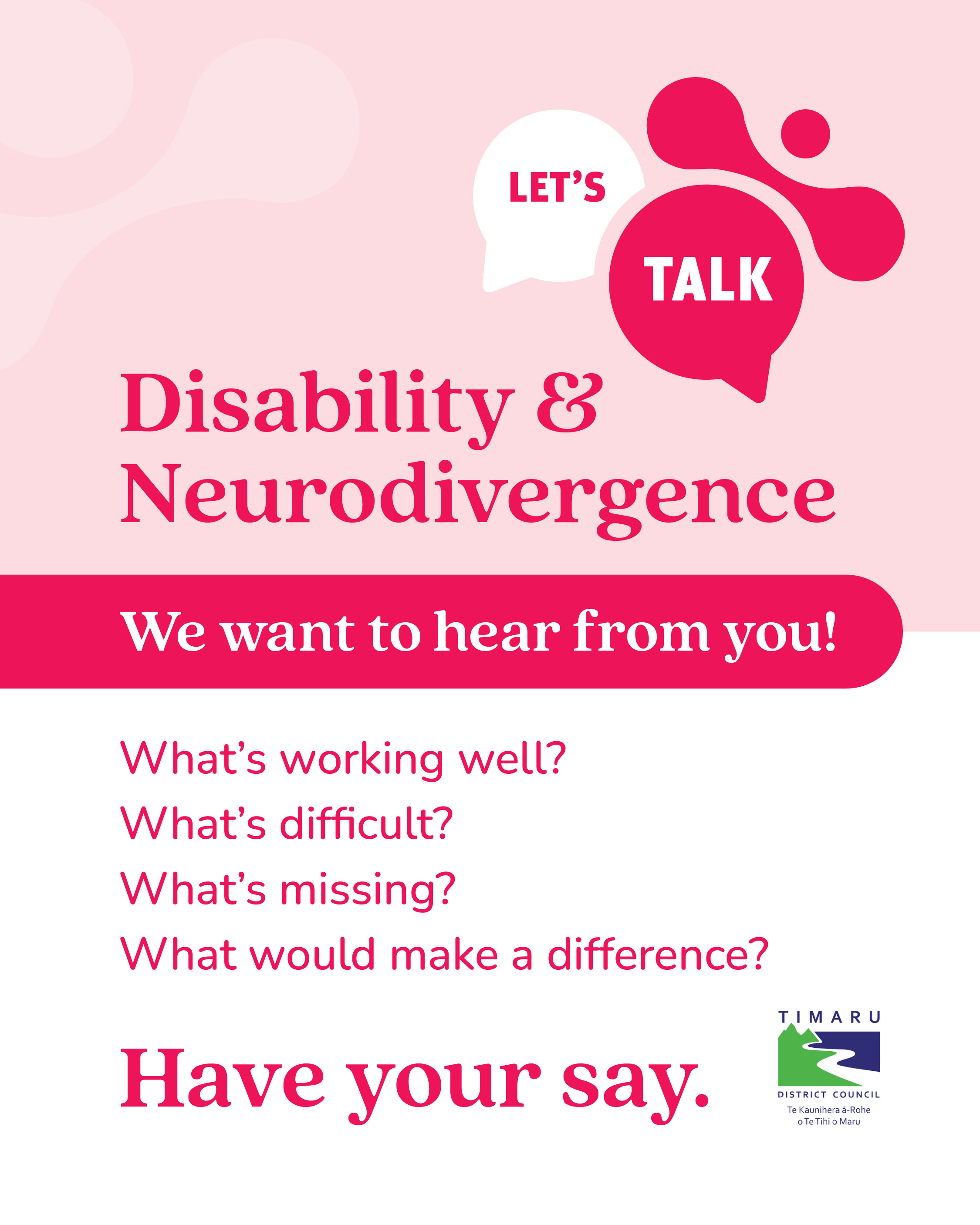
What are we interested in?
This project isn't only about identifying problems.
We also want to understand what's already working well.
We want to hear about the activities, groups, places, services and connections that people value, and what helps disabled and neurodivergent people feel part of their community.
We also want to understand what people would like to do or be involved in but currently can't, and what might be getting in the way.
Another part of the conversation is about having a voice. We want to understand whether disabled and neurodivergent people have enough opportunities to contribute to local decisions that affect them, and what better involvement could look like.
We aren't starting with a particular model or solution. We want to hear people's ideas first.
More than just a survey
The survey is only one part of this engagement.
We will also be listening through:
- Community Kōrero;
- one-to-one conversations;
- conversations with disabled and neurodivergent young people where appropriate; and
- interviews with organisations and services.
We'll bring together what we hear across all of these conversations when developing the recommendations.
This is important because we want to hear from people in different ways, including people who may not already be connected with disability services or organisations.
What will happen with what we hear?
We haven't decided what the recommendations from this project will be. We want to listen and learn first.
What people tell us will help us build a clearer picture of what matters to disabled and neurodivergent people and their whānau across the Timaru District.
We'll bring together what we hear and use it to develop clear, practical recommendations for making community life more inclusive. We'll then look at who we can work with to put those recommendations into action, and what funding or other support might be needed.
Disabled and neurodivergent people and their whānau will help shape what we recommend and what happens next. This reflects the principle of "Nothing about us, without us."
Accessibility
We want people to be able to participate in a way that works for them.
You can complete the survey yourself or with someone you trust, attend a Community Kōrero with a support person, or talk with us directly.
Easy Read information about the project is also available.
If you need the information in another format, or need another way to participate, please contact the Community Partnerships team.
Community Partnerships
Timaru District Council
jessica.hurst@timdc.govt.nz
What happens next?
Once the engagement is complete, we'll bring together what we've heard through the survey, Community Kōrero, one-to-one conversations and discussions with organisations and services.
We'll look for common themes, strengths, barriers, gaps and opportunities.
From there, we'll develop practical recommendations and look at:
- what could be done locally;
- where Council may have a role;
- where we can work with community organisations, services or other agencies;
- where advocacy may be needed; and
- whether funding or other support may help turn recommendations into action.
Most importantly, we'll report back on what we heard, what we recommend and what happens next. This matches the approach you settled on for the survey, where this is one part of a wider conversation rather than a standalone Council consultation.
Last updated: 28 Oct 2026